SEQUENCE : SCOTLAND


 The national  flag of Scotland or  Saint Andrew's flag

 30 November - The national day of Scotland’s is St Andrew's Day . St Andrew is the patron saint of Scotland.
  St. Andrew was one of Christ's twelve apostles. Some of his bones are said to have been brought to what is now St. Andrews in Fife during the 4th century. 
Since medieval times the X-shaped saltire cross upon which St. Andrew was supposedly crucified has been the Scottish national symbol.


 The national emblem: the thistle

 The national emblem and national flower of Scotland is the thistle, a prickly-leaved purple flower which was first used in the 15th century as a symbol of defence.


Scotland is Famous for.... 

Its fresh water lochs (lakes) – there are over 600 square miles of them. One of the most famous is Loch Ness where a mysterious monster is said to lurk in the depths of the water.
It is also famous for its clans, kilts, medieval castles, as well as poetry and songs of Robert Burns.
Theatre lovers from around the world come to Edinburgh for its famous theatres festival.


EDINBURH (the capital)
Edinburgh has been the capital of Scotland since 1999 again. It is the second most populous city of the country. The Scottish capital is an important cultural and scientific centre, as well as the second most important centre of finance after London.
During the 19th century, Edinburgh was called ‘Auld Reekie’ because of the smoke from the steam engines and the pollution of the Industrial Revolution. Another nickname was ‘the Athens of the North’ because of the neoclassical style of some of its buildings and monuments.
The most famous street in Edinburgh is the Royal Mile which leads to Edinburgh Castle. 


 Edinburgh Castle was built during the 12th century. It is situated on top of an extinct volcano.


When you visit the castle, you can see the Scottish Crown Jewels, also known as the Honours of Scotland. The crown was made in 1540. 


You can also admire the Stone of Destiny which has been used for coronation ceremonies for many centuries. In 1292, the Stone of Destiny was taken from Scotland to Westminster Abbey, in London by King Edward I of England. In 1950, four students took the Stone from Westminster Abbey for return to Scotland. The Stone was found a few months later. In 1996, Queen Elizabeth II allowed the Stone to be returned to Scotland, after 700 years.


Two other famous attractions at Edinburgh Castle are Mons Meg and the One o’clock Gun
Mons Meg is one of the oldest cannons in the world. It is over 550 years old. 
The One o’clock Gun is fired every day at 1 p.m. In the past,it was a time signal for ships.


 GLASGOW

Glasgow is the largest city in Scotland. The name ‘Glasgow’ comes from a Gaelic word which means ‘Dear green place / space’. The bishopric of Glasgow was set up in the 12th century and the University of Glasgow was founded in the 15th century.

Today, Glasgow is both an old and modern city, famous for its museums and art galleries. There are over 20 museums and art galleries in Glasgow.
 The biggest museum is Kelvingrove. It is the most popular UK museum outside London.  As for the Burrell Collection, it is the largest private collection of artwork in the world.

Another thing this Scottish city is known for is its architecture. Glasgow’s most famous architect is Charles Rennie Mackintosh, the founder of Art Nouveau.
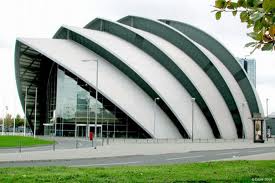


Glasgow has recently started a regeneration programme with the construction of very modern buildings such as the Clyde Auditorium, also known as ‘The Armadillo’, and the Clyde Arc or ‘The Squinty Bridge’.


INVERNESS
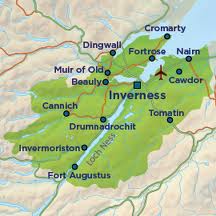

Inverness is the capital of the Highlands and it is also the northernmost city in the United Kingdom. It is situated on the river Ness.

Inverness was founded in the 6th century. The town was a stronghold (= a castle or place that is strongly built and difficult to attack) for the Picts.
There are about 40,000 inhabitants and the city is a major transport hub (= the most important and central part) for the region.


FOOD

The national dish is the HAGGIS ( « panse de brebis farcie »)

Scotland is famous for its game and salmon, the national dish is haggis and neeps (innards and offal chopped up with spices and cooked in a sheep's stomach, served with mashed turnip).

Haggis is made from lamb’s offal (lungs, liver and heart) mixed with suet, onions, herbs and spices, all packed into a skin bag traditionally, but not usually now, made of a sheep’s stomach. Haggis is often served with mashed potatoes and mashed swede or turnips. It is traditionally served on Burns’ Night.
                                THE HIGHLANDS GAMES

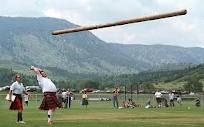
The Highlands Games celebrate Scottish and Celtic culture and heritage especially those of the Scottish Highlands

1 – What are the origins of these games ?

Th Highlands games have their origins in the Scottish clan system.They are over 300 years old.The clan chief encouraged his men to participate in competitions of physical strengh (=force) and endurance.They proved they were ready for battles against the English !
The Games are a way to commemorate Scottish history.

2 Where and when do these games take place ?
 
The games take place throughout (= à travers toute) Scotland between May and September.

The most famous are held (=se déroule) in the late summer at the Bremar Gathering , and the Royal family attends.

The Cowal Highlands festival in Dunoon , every August, is the largest Highland Game in Scotland.It attracts 3,500 competitors and between 15,000and 20,000 spectators.
3 – What do these games consist of ?

The Highland games are a mix of sports,culture  and social activities.there is usually a programme of " light events " : athletics , piping and dancing competitions.

And there are typically Scottish" heavy events" : the shot putt , tossing the caber , the tug-o-war and the putting the stone.

Shot Putt


tug-o-war


putting the stone


THE LOCH NESS

 Special thanks to Léa for her oral presentation !


tossing the caber


MAY DAY


The first day of the month of May is known as May Day. It is the time of year when warmer weather begins and flowers and trees start to blossom. It is said to be a time of love and romance. It is when people celebrate the coming of summer with lots of different customs that are expressions of joy and hope after a long winter


Traditional English May Day celebrations include :

Morris dancing, a traditional English form of folkdancing, performed by groups of men or women.


 crowning a May Queen


and dancing around a Maypole.


On May Day, people used to cut down young trees and stick them in the ground in the village to mark the arrival of summer.
People danced around the tree poles in celebration of the end of winter and the start of the fine weather that would allow planting to begin.


The beginning of Summer
Although summer does not officially begin until June, May Day marks its beginning. May Day celebrations have been carried out in England for over 2000 years.
The Romans celebrated the festival of Flora, goddess of fruit and flowers, which marked the beginning of summer. It was held annually from April 28th to May 3rd.

May Day Bank Holiday
The month of May has many traditions and celebrations. For the convenience of the general public, many May Day activities have now been moved to the new May Day holiday (from 1978) on the first Monday of the month. This Monday is a bank holiday, a day off school and work.

Many of the May Day celebrations take place at the weekend as well as on the 'May Day' Monday. The weekend is know as bank holiday weekend because it comes with the extra day holiday on the Monday.


Are there any special foods for this celebration?                              No

Is there any special person associated with this holiday?                  No

Are there special types of clothing for the celebration of May Day? People who are performing  dress up. (See Morris dancing)


EASTER


How well do you know about the history of Easter?Test your knowledge!!


A few historical reminders :
Easter was originally a pagan festival.
The ancient Saxons celebrated the return of spring with a festival commemorating their goddess of offspring and of springtime, Eastre.
The Christian missionnaries who wanted to convert them decided to do so by allowing them to continue to celebrate pagan feasts, but to do so in a Christian manner. And as the pagan festival of Eastre happened  at the same time of year as the Christian observance of the Resurrection of Christ.....
A few symbols :
 
The Easter Bunny  : it was the symbol of the goddess Eastre   
 
The Easter egg  : The exchange of eggs in the springtime is a very old custom .  The egg was a symbol of birth in most cultures 


EASTER RECIPES:

The Hot Cross Buns   . Yummy and scrummy !
 These buns are traditionally eaten hot or toasted on Good Friday ( Vendredi Saint) , with the cross standing as a symbol of The Crucifixion.


Baby Chick Easter Cupcakes     

Ingredients:
  • 1 (18.25 oz.) pkg. devils food cake mix
  • 2 (16 oz.) can vanilla ready to spread frosting
  • Yellow food coloring
  • 48 white dessert mints
  • 48 miniature baking chip
  • 48 pieces of candy corn
Preparation:
  1. Prepare and bake the cake according to the package directions for 24 cupcakes.
  2. Allow the cupcakes to cool completely before decorating.
  3. Tint both cans of frosting with the yellow food coloring.
  4. Using a pastry bag with a #17 star tip, pipe the frosting to cover each cupcake.
  5. Pipe on 2 wings per chick by pulling back on the bag as the frosting is released.
  6. Pipe a small mound of frosting onto each cupcake for the chicks head.
  7. Place two dessert mints on the head of each chick for eyes. 
  8. Use a toothpick and dab a very small amount of frosting in the middle of each dessert mint.
  9. Attach a miniature baking chip to each of the chick's eyes.
  10. Place 2 pieces of candy corn, large ends slightly angled one up and one down into the frosting to make the beaks.
Makes 24 cupcakes
Preparation Time:  approximately 30 minutes
Total Time:  approximately 1 hour 25 minutes
+ cooling time
EASTER TONGUE TWISTERSto tangle your tongue...

Can you say these ten times fast??!
1.  Busy bunnies bring blue baskets. 
2. Each Easter, Eddie eats eighty eggs.
3. Six peeping chicks cheeping cheerily.
4. Jogging jellybeans joke and giggle,
    jogging jellybeans jump and jiggle.
5. Run, Red Rabbit, run!

SEQUENCE: IRELAND

 Test your knowledge about Ireland

Take a virtual voyage through Ireland's most amazing sites by clicking:
                                                               Ireland
National Dishes
 Ireland is famous for its seafood with smoked salmon, smoked fish, oysters, mussels and
crab topping the bill. The country also produces excellent lamb, beef pork, black pudding,
farmhouse cheese, soda bread and, of course, Guinness and maybe a drop of whiskey!


Irish stew, "ballymaloe" or "stobhach gaelach" as it is called in Gaelic,is a traditional dish made from lamb or mutton as well as potatoes,onions, and parsley. It is a filling, flavourful dish made with the cheapest, most readily-available ingredients. The Irish raised primarily
sheep and root crops for subsistence. The sheep provided wool for warm clothing, milk for drinking and making cheese, and eventuallyfood. Potatoes were the main food crop, prior to the potato famine.


Colcannon is a traditional Irish food made from mashed potatoes, cabbage (or kale), butter, salt, and pepper. It can contain other ingredients such as milk, cream, leeks, onions, chives or garlic. It is a cheap, year-round staple food. 
An Irish Halloween tradition is to serve colcannon with prizes of small coins concealed in it.


Traditional Irish Breakfast - This is one of the glories of the Irish table and can include grilled bacon, black pudding (= boudin noir)and good quality sausages, tomatoes grilled with butter and chives, flat mushrooms and soda and potato bread. Nowadays, with the more hectic lifestyle, it is confined to weekend treats and holidays - not to be missed, it sets you up for the day!


Special thanks to Rémi for his oral presentation on the Irish group U2!:


  • The popular Irish group U2 composed the song"Sunday Bloody Sunday " in 1983.It sums up a decade of passion, hatred and violence.


CELEBRATIONS : St PATRICK'S DAY!!

17th March
Happy St Patrick's day!!


Don't forget to wear green ! You will be pinched otherwise...be careful!! 

Thanks to Justine and Fanny for their oral presentation about St Patrick's Day!! Good job!

Here is the video:
1st part:
2nd part:


What do you know about St Patrick's Day? Test your knowledge !

Do the following quiz 
http://news.bbc.co.uk/cbbcnews/hi/newsid_4810000/newsid_4816300/4816346.stm
                                                                

 In the United States and in Great Britain , the Irish communities celebrate Saint Patrick’s Day which is on 17 March.

The Irish community
in the USA is very big. During the 1800’s thousands of Irish immigrants went to America to escape poverty and have a better life. They settled in all parts of the country and took their traditions with them.

Who is Saint Patrick and why is he important to the Irish ?


Saint Patrick is the patron of Ireland. He left several writings about his life and work in Ireland.

Saint Patrick 
whose father was a landowner and a Christian was born in Britain in 389 AD. When he was sixteen years old he was captured and taken to Ireland where he became a slave. After six years he escaped to France where he became a priest. (un prêtre)

In 432 AD he returned to Ireland as a bishop in order
to convert most of the Irish to Christianity. He was a generous man and dedicated man  who also introduced the Roman alphabet to Ireland.

There are legends about Saint Patrick. One legend says that he banished all the serpents from Ireland,
which  is probably not true ! Another legend says that he used a shamrock to teach the Irish about the Trinity. (= The Father, The Son, The Holy Spirit), St Patrick used a shamrock.
Today the shamrock he used is still a symbol of Ireland and the Irish.

Saint Patrick died in 461 and his tomb which is at Downpatrick is a centre of pilgrimage.

Today on March 17th there are big parades in big American cities in honour of the Irish . Marching bands dressed in green play lively Irish music. The Irish community organises parades and other colourful events


American and British people wear green clothing on Saint Patrick’s Day. 
The Chicago River is even dyed in green


 Most people wear a green shamrock. Many shops and restaurants are decorated with green shamrocks in honour of the Irish.


Not to forget the Leprechaun who is a solitary creature, whose principal occupation is making and mending shoes, and who enjoys practical jokes.He is said to possess a treasure and if you capture him and theaten( menacer) him , he can tell you where he has hidden it...  
 

Here is the video : St Patrick's Day parade 2012 in Dublin. Enjoy!


In New York (2012)


LET'S PLAY the Snake Game!! 


Snakes alive! Saint Patrick is driving the snakes out of Ireland. Can you avoid his traps and become the biggest serpent on the block?