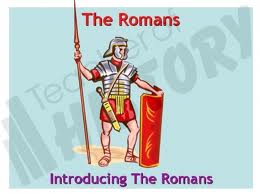
THE ROMANS


The itallian flag Romans came to English flag Britain nearly 2000 years ago . 
Even today, evidence of the Romans being here, can be seen in the ruins of Roman buildings, forts, roads, and baths can be found all over Britain.
The Romans invaded other countries too. The Roman Empire covered much of Europe, north Africa, and the Middle East.


Roman helmetWhen did the Romans invade Britain?
First invasion - Caesar's first raid
 In August 55 B.C. (55 years before Jesus was born) the Roman general, Emperor Julius Caesar invaded Britain. He took with him two Roman legions. After winning several battles against the Celtic tribes (Britons) in south-east England he returned to France.

Second invasion - Caesar's second raid
The following summer (in 54 B.C.) Caesar came to Britain again landing at Walmer near Deal in Kent. This time he brought with him no fewer than five legions (30,000 foot soldiers) and 2,000 cavalrymen (horse riders). This time the Romans crossed the River Thames. After more fighting, the British tribes promised to pay tribute to Rome and were then left in peace for nearly a century.


Kent as it owuld have looked as the time of the Roman invasionThird and final invasion
Nearly one hundred years later, in 43 A.D. (43 years after Jesus was born), Emperor Claudius organised the final and successful Roman invasion of Britain. General Aulus Plautius led four legions with 25,000 men, plus an equal number of auxiliary soldiers. They crossed the Channel in three divisions, landing at Richborough, Dover, and Lympne.


Roman helmetWhy did the Romans invade Britain?
Why the Romans came to Britain is not quite certain. Two reasons have been suggested:
  1. The Romans were cross with Britain for helping the Gauls (now called the French) fight against the Roman general Julius Caesar. 
  2.  
  3. They came to Britain looking for riches - land, slaves, and most of all, iron, lead, zinc, copper, silver and gold.
Roman helmetHow long did the Romans stay in Britain?
The Romans remained in Britain from 43 AD to 410 AD. That is almost four hundred years (four centuries).
Roman helmetWhy did the Romans leave Britain?
Their homes in Italy were being attacked by fierce tribes and every soldier was needed.
Roman helmetWhat did the Romans call London?
The Romans called London 'Londinium'.
The River Thames was quick way to transport goods between Britain and the Continent. The Romans saw this and built the town of Londinium around the river's main crossing point.

Roman helmetWhy was the Roman Empire important?
The Romans, even today, play an important part in our lives. Many of the things we do or have originated from the Romans.
                                   
                                                              QUIZ

To revise your lessons: :http://www.brims.co.uk/romans/
Test your knowledge on Romans:do the following quiz :

http://www.brims.co.uk/romans/quiz.html


SEQUENCE : HISTORY 1- THE CELTS


Revisions for your test  (Wednesday 21st November):

1 - Dig deep into the lives of the Iron Age Celts through games, stories and activities.:Click on the following link:: http://www.bbc.co.uk/wales/celts/

2- How well do you know your lessons?
Do this quiz !!Click on the following link:http://www.caedraw.merthyr.sch.uk/CAEDRA~1/Celts_Quiz.html


Remembrance Day

Remembrance Day in Britain


November is the time of the year when we wear a red poppy in memory of those who sacrificed their lives for us during wars.
Click here to go to the British legion website
The eleventh hour of the eleventh day of the eleventh month marks the signing of the Armistice, on 11th November 1918, to signal the end of World War One.

At 11 am on 11 November 1918 the guns of the Western Front fell silent after more than four years continuous warfare.
poppy iconWhat is Remembrance Day?
Remembrance Day is on 11 November. It is a special day set aside to remember all those men and women who were killed during the two World Wars and other conflicts. At one time the day was known as Armistice Day and was renamed Remembrance Day after the Second World War.

Remembrance Sunday is held on the second Sunday in November, which is usually the Sunday nearest to 11 November. Special services are held at war memorials and churches all over Britain.
This year it is on 11 November!

A national ceremony takes place at the Cenotaph in Whitehall, London. The Queen lays the first wreath at the Cenotaph.


image: Map of Whitehall


Cenotaph
The Cenotaph in White Hall

Wreaths (= couronnes) are layed beside war memorials by companies, clubs and societies. People also leave small wooden crosses by the memorials in remembrance of a family member who died in war.


poppy iconPoppy Day
Remembrance Day is also known as Poppy Day, because it is traditional to wear an artificial poppy. They are sold by the Royal British Legion, a charity dedicated to helping war veterans.
poppy iconTwo minute silence
At 11am on each Remembrance Sunday a two minute silence is observed at war memorials and other public spaces across the UK.

Remembrance Day quiz

How much do you know about the origins of Remembrance Day? 15 Questions.

BRITISH FESTIVITY : GUY FAWKES NIGHT

Guy Fawkes
           
             Guy Fawkes Night (Bonfire Night)

 Thanks to Elisa and Léa for their presentation on Guy Fawkes !!


 image: barrel
On 5 November 1605, the infamous Gunpowder Plot took place in which some Catholics plotted to blow up the English Parliament and King James l, on the day set for the king to open Parliament. The men were angry because the king had treated them badly and they didn't like it.
The story is remembered each 5th November when 'Guys' are burned in a celebration known as "Bonfire Night".


Why did Guy Fawkes want to kill King James 1st and the king’s leaders?


James 1When Queen Elizabeth 1st took the throne of England she made some laws against the Roman Catholics. Guy Fawkes was one of a small group of Catholics who felt that the government was treating Roman Catholics unfairly. They hoped that King James 1st would change the laws, but he didn't.
Catholics had to practise their religion in secret. There were even fines for people who didn't attend the Protestant church on Sunday or on holy days. James lst passed more laws against the Catholics when he became king.


What happened - the Gungpowder Plot

A group of men led by Robert Catesby, plotted to kill King James and blow up the Houses of Parliament, the place where the laws that governed England were made.


Guy Fawkes was one of a group of men

 The plot was simple - the next time Parliament was opened by King James l, they would blow up everyone there with gunpowder. The men bought a house next door to the parliament building. The house had a cellar which went under the parliament building. They planned to put gunpowder under the house and blow up parliament and the king.

Guy Fawkes Discovered
GuGuy Fawkes was given the job to keep watch over the barrels of gunpowder and to light the fuse. On the morning of 5th November, soldiers discovered Guy hidden in the cellar and arrested him. The trail of gunpowder at his feet would never be lity hidden in the cellar and arrested him. The trail of gunpowder at his feet would never be lit.


Guy Fawkes was taken to the Tower of London

image: tower of london


He was tortured and questioned about the other plotters. To start with he didn't tell the soldiers anything about the plot. But, eventually he started to tell the truth


A Celebration

In celebration of his survival, King James ordered that the people of England should have a great bonfire on the night on 5th November.

Today Bonfire Night is celebrated all over the UK

        IN ENGLAND:
Throughout England, towns and villages....
  • light huge bonfires,
  • let off magnificent fireworks,
  • burn an effigy (a homemade model of a man, like a scarecrow) and
  • celebrate the fact the Parliament and James I were not blown sky high by Guy Fawkes 
Penny for the Guy

During the days before Bonfire Night, children used to take their home-made guys out on the street and ask for "a penny for the Guy" for fireworks. 


Traditional Bonfire Night Food

As well as burning effigy of Guy Fawkes, the bonfires are used to cook potatoes wrapped in foil (= papier alu) and to heat up soup for the crowds that come to watch the fireworks
The traditional cake eaten on bonfire night is Parkin Cake, a sticky cake containing a mix of oatmeal, ginger, treacle and syrup.
Other foods include sausages cooked over the flames and marshmallows toasted in the fire.

GAME


Test your knowledge of the Gunpowder Plot with this interactive quiz.

http://www.bbc.co.uk/history/british/civil_war_revolution/launch_gms_gunpowder_plot.shtml

BRITISH FESTIVITIES:Halloween

                                                                      HALLOWEEN

 Halloween


Thanks to Mathilde and Emma for their great  presentation !!


Thanks for the sweets!!


                                                  HISTORY  
 
Halloween is a special holiday for English and American children. They celebrate it on October 31st. It is on the day before All Saints' Day.
october

The origins of Halloween are very ancient.
One of the symbols of this festival are large orange pumpkin lanterns called Jack o' Lanterns.          pumpkin
The lanterns are made from pumpkins carved in the appearance of a scary face.
children with pumpkin
They have got a candle inside and they are hung on trees or put by windows, so you can see them in the dark.               animated pumpkin
Children make the lanterns to frighten witches and ghosts.
In the evening children put on scary costumes and masks and they go out. In the street you can see ghosts, witches, skeletons, pirates, wizards and other different costumes.
trick or treat?
They go from house to house, they knock on the door and when people open, children say:
Trick or treat! Smell my feet!       
      Give me something good to eat!

People usually give them money, sweets, candies, apples and nuts. But sometimes children get nothing, so they play a trick!

Happy Halloween

                                                     TRADITIONS
 

Halloween means "All Hallows Eve", the evening before All Saints. Halloween is a popular event in America , Great Britain and Ireland. Both adults and children alike celebrate All Saints Eve. The children dress up in funny clothes and masks .They go round the houses, ring the door- bells and say: "Trick or treat". People give them some candy, fruit, money, or they play a trick , like writing on windows with soap, ringing door-bell, spray shaving cream on cars, dumping garbage can.


Pumpkin People make faces out of large pumpkins and put candles inside: this is called Jack O'Lantern. They cut out ghosts and spectres and even skeletons and put them in their windows. Teenagers in middle school and high school have a Halloween party and dance. The party is in the evening in the school gymnasium. After the school party, everyone helps to clean up.
 
At home and at school children play games such as "dunking for apples", "applesPumpkin pie on a string", and others. Typical Halloween food is nuts, popcorn, pumpkin pie, liquorice, sweets and candied apples. The Halloween drink is apple cider.

                                             Vocabulary and games

Revise your vocabulary and play these two games!
http://www.marks-english-school.com/games/halloween.html
  
                                                          QUIZ
 http://www.buzzle.com/articles/halloween-quiz-questions-and-answers.html